.png)
The Pharmacist's Expanded Role in Africa's Health Ecosystem
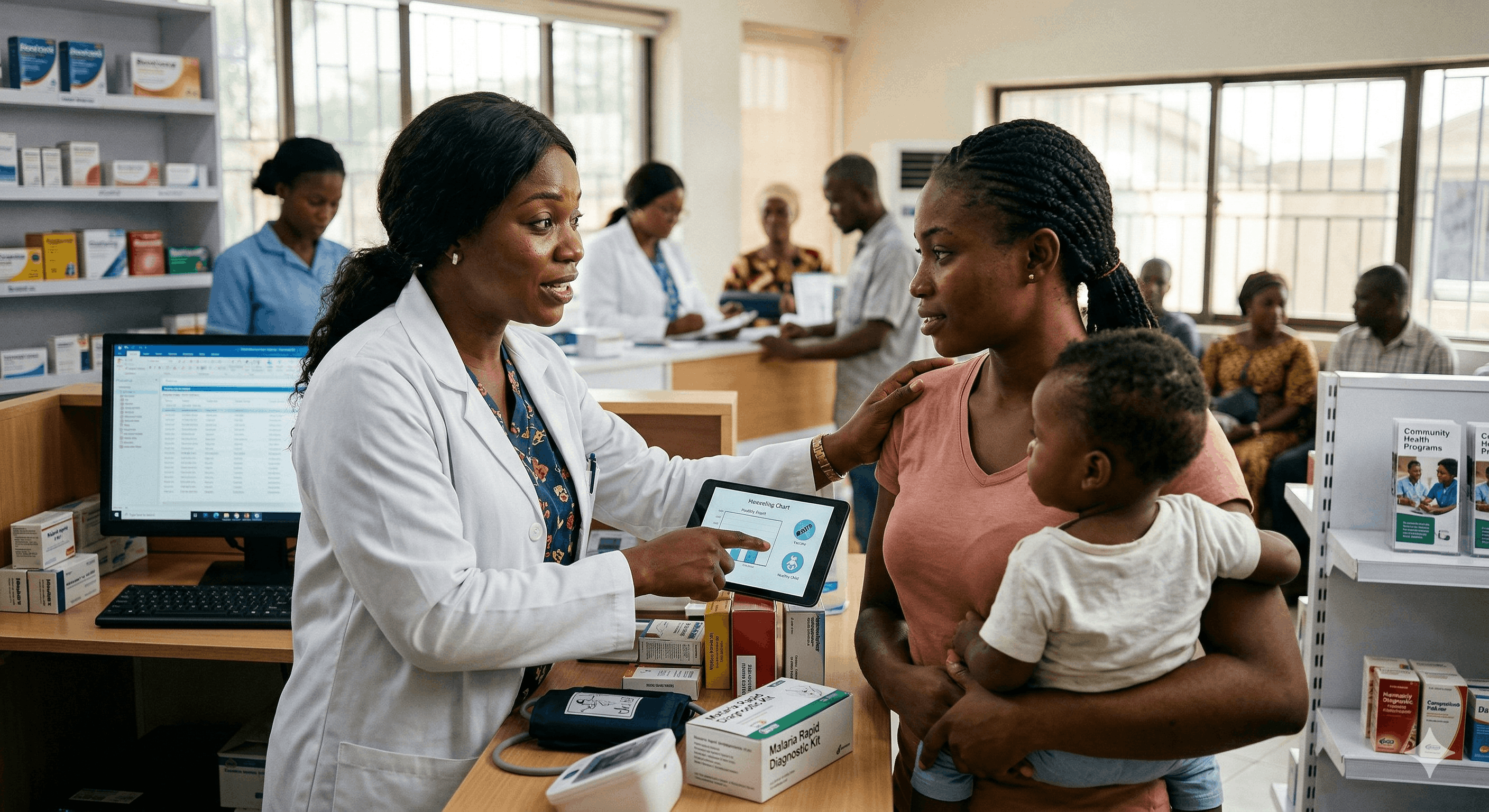
I have watched patients walk past government clinics — empty, locked, or simply too far — and into a community pharmacy instead. The pharmacist who receives them is doing the work of a GP, a counsellor, and a supply chain manager, often for a few hundred naira. We need to stop pretending this is not happening and start building systems around it.
There is a scene I have witnessed in variations across Nigeria, Ghana, and Sierra Leone, so many times that it has become almost unremarkable to me. A mother carries her child into a neighbourhood pharmacy. The child is febrile, listless, probably malaria. The pharmacist — working from a tiny dispensary behind a counter stacked with products — asks a series of rapid questions, recommends an RDT test, interprets the result, counsels on treatment, dispenses the correct dose of artemisinin combination therapy, and gives instructions for follow-up. The whole interaction takes less than fifteen minutes. The mother leaves with what she needs.
Across the street, the government primary health care centre is closed. Or understaffed. Or out of stock. Or simply too far from the woman's home for a sick child to reach on public transport.
What the pharmacist just did — in that cramped, busy, under-resourced dispensary — is primary healthcare. But in most of our policy frameworks, regulatory structures, and financing systems, it is treated as retail commerce.
This is one of the most significant structural failures in how we think about health systems in Africa. And it has a solution, if we are willing to take it seriously.
What I Learned From My Own Beginning
I graduated from the University of Benin Faculty of Pharmacy in the early 1990s. My training was rigorous and largely product-focused: pharmacology, pharmaceutical chemistry, dispensing practice, drug interactions. I knew how drugs worked. I knew the regulatory environment. I understood quality assurance and supply chain fundamentals.
What I was not trained for — what no one explicitly prepared me for — was the reality of practice in the Nigerian context. The patient who has self-medicated for three weeks before coming to me. The family buying fractional doses because they cannot afford a full course. The community health worker who refers patients to me because the clinic is consistently out of stock. The informal medicine seller around the corner who competes for the same customer with products of unknown quality.
I had to learn the actual landscape on the job. And what it taught me, over years of working in both community practice and large-scale public health programmes, is that the pharmacist occupies a unique position in the African health system — one that formal policy has consistently undervalued and underutilised.
The Trust That Already Exists
Here is something that rarely appears in policy papers but is obvious to anyone who has spent time in African communities: people trust pharmacists.
Not in the abstract, brand-reputation sense. I mean something more immediate and more personal. They trust the specific pharmacist in their neighbourhood. The one who knows their name, knows their chronic conditions, knows which products they have reacted badly to in the past. They will tell that pharmacist things they would hesitate to say in a formal clinical consultation — because the pharmacist is accessible, familiar, and unburdened by the power dynamics of a hospital setting.
This trust is built through proximity and consistency. A community pharmacist sees the same patients repeatedly, across years, across life stages. They give advice at 7pm when the clinic is long closed. They extend credit when a family is short. They follow up informally, by recognising a face in the market and asking how the child is recovering.
That is not just good customer service. That is what functional primary healthcare looks like. And it is happening, at scale, across thousands of community pharmacies across West Africa, largely unrecognised by the systems that should be amplifying and supporting it.
The Integration Gap
So why hasn't this translated into formal recognition? Why are pharmacists still largely excluded from primary care platforms, from community health worker training networks, from national health data systems?
Part of it is historical. The division between "clinical" healthcare — doctors and nurses — and "dispensing" practice has deep roots in colonial health system design. Those divisions have calcified into professional hierarchies that are difficult to dislodge, even when the evidence argues for something different.
Part of it is political economy. Integrating pharmacists into formal primary care delivery means redistributing clinical authority and — potentially — funding. That creates resistance from stakeholders who benefit from the existing arrangement.
And part of it, I will admit, is that the pharmacy profession has not always advocated effectively for itself. We have sometimes been content to operate in the retail space without pushing for the policy changes that would formalise what we already do in practice.
Three Things That Must Change
I am not a policy theorist. I am a practitioner. So let me be specific about what I believe needs to happen.
First, formal integration into primary care delivery systems. Pharmacists should be on national community health platforms — not as peripheral referral points, but as primary contact providers with defined clinical scope. The training infrastructure exists. What is missing is the political will to use it.
Second, pharmacy education that reflects practice reality. A pharmacy graduate in Nigeria today should leave university able to conduct a basic clinical assessment, interpret a malaria RDT, recognise the warning signs of sepsis, counsel on maternal and child health, and navigate the public-private interface of the health market. These are not aspirational competencies. They are what the job already requires. Our curricula need to catch up.
Third, payment models that reward quality care, not just volume. Community pharmacies are currently incentivised by product sales margins. That creates misalignments — the more products dispensed, the better the revenue, regardless of whether dispensing was appropriate. Performance-based contracting models that reward health outcomes — like those being piloted in some social franchise programmes — point toward a more sustainable model. We need to scale what works.
A Personal Note
I have built much of my career in public health rather than community practice. But I have never stopped thinking of myself as a pharmacist first. The profession shaped how I approach problems — with attention to the detail of the product, to the reality of the patient, and to the systems that connect them.
Africa cannot achieve universal health coverage without pharmacists at the centre of the plan. Not as an adjunct to the health system. As a primary pillar of it. The infrastructure is already there, in thousands of neighbourhood dispensaries across the continent. We just need the courage to build on it properly.